
Selected published contributions
Media.
The experience and perspectives gained from ongoing engagement with governance, responsibility and the ability to act under pressure inform various public formats – including lectures, publications, conversations and other media contributions.
Addressing these relevant issues is one preventive measure to protect our economy and society from unconscious misconduct that may lead to compliance breaches, white-collar crime and cybercrime.
It helps sharpen awareness of corporate integrity, corporate governance and risk management. Knowledge and preparation strengthen resilience.
Knowing what matters protects assets
Mastering challenges together.
The content of the following three publicly accessible formats is drawn from concrete situations and practical questions.
They are intended for decision-makers dealing with decision quality, integrity and leadership in complex situations.
01.
Book.
The book is a condensed examination of a central aspect of my work: the human factor in the context of governance, risk and integrity.
It focuses on why organisations lose orientation despite existing structures – and why incidents rarely fail because of rules, but because of decision-making and behavioural patterns.
02.
podcast.
In the podcast THE HUMAN FACTOR: Corporate Integrity Matters, I explore governance and integrity issues in conversation with decision-makers and experts from various industries.
The podcast is designed as an impulse format. It provides context for complex questions around corporate integrity, governance, human risk and leadership in stable times as well as in exceptional situations.
03.
blog.
Based on more than 30 years of professional experience in dealing with complex situations, I offer insights, reflections and practical impulses.
The blog serves as an archive of these reflections. It does not follow a publication schedule.
For leaders who place integrity, clarity and transparency above noise, and impact above vague intention.
Knowledge creates transparency
Keynotes
As a further element in raising awareness and strengthening corporate integrity and resilience, I speak in a practice-oriented way about governance, responsibility and the ability to act. I use anonymised practical examples in which formal structures are in place, yet the ability to act comes under situational pressure.
My perspective is shaped by responsibility-sensitive decision-making situations at board and executive level – in stable phases as well as in crises.
a.
Context instead of recipes
In practice, governance rarely fails because rules are missing. More often, it fails because of human behaviour, delayed decisions or the desire for reassurance rather than clarity.
My lectures make sense of these dynamics. They do not explain how organisations should function. They make visible how responsibility is exercised in reality – and why integrity and consistency in action are decisive under pressure.
b.
Experience from demanding contexts
This perspective is complemented by experience from demanding contexts, including offshore sailing. Decisions under time pressure, with limited information and changing conditions, are part of everyday reality there.
These experiences serve as an analogy for leadership and governance in complex situations: preparation, role clarity and considered action matter more than perfection.
c.
Formats and target audiences
My keynotes and panel contributions are primarily aimed at:
- Board members
- Audit Committees and
- Others carrying responsibility in complex environments.
They offer context, orientation and reflection on responsibility and the ability to act under pressure.
These contributions appear in various formats, including interviews, specialist articles and guest contributions. They provide practical, factual context for complex issues.
Media contributions typically address the following contexts and topics:
- Governance and responsibility at board and executive level
- The ability to act under pressure and in crises
- Risk, non-compliance and human risk
- Integrity, trust and reputation
- Decision dynamics in uncertain situations
This page brings together publicly accessible formats. It is deliberately curated and does not claim to be exhaustive.
Get Access to an excerpt of published Information
press Media.
Supporting the press with facts and figures helps to raise awareness for Corporate Integrity, Governance, Risk and Compliance and is one of the preventional steps towards protecting our economy and society from misbehaviour resulting in Non-compliance, White-collar and Cybercrime.
Get Access to an excerpt of published Information
press Media.
Supporting the press with facts and figures helps to raise awareness for Corporate Integrity, Governance, Risk and Compliance and is one of the preventional steps towards protecting our economy and society from misbehaviour resulting in Non-compliance, White-collar and Cybercrime.

The talented Mr. Vossen - new insights into the millionaire fraudster
NDR Info continues the podcast “The Talented Mr. Vossen – Hunt for a Millionaire Fraudster” with the second season, almost seven years after the last episode.
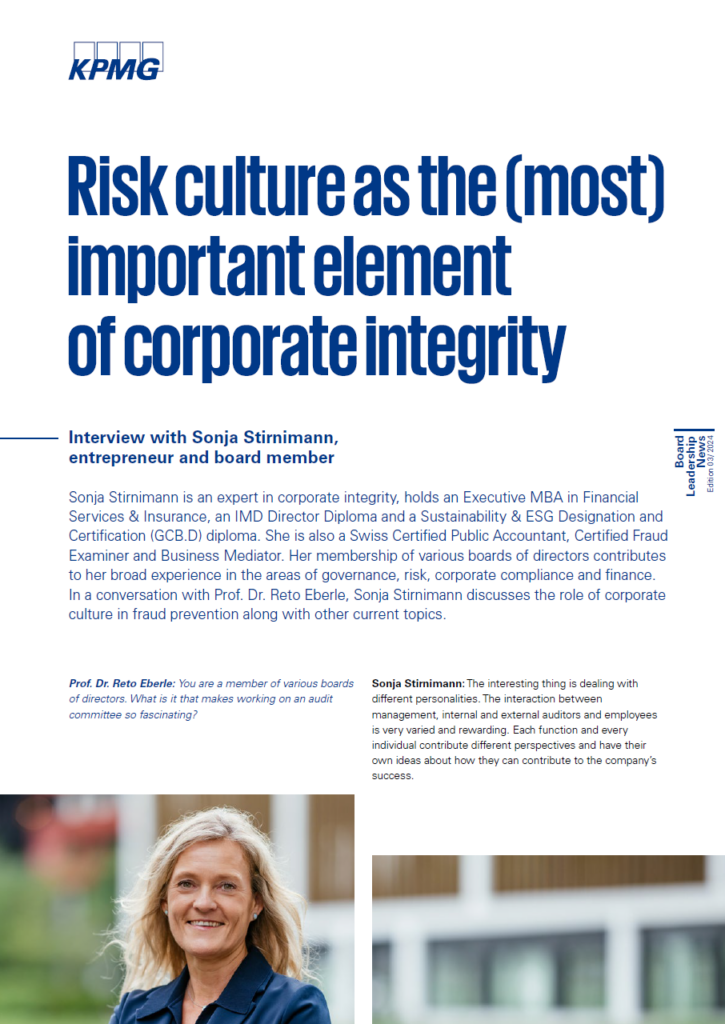
Risk culture as the (most) important element of corporate integrity.
Interview with Sonja Stirnimann on the role of corporate culture in fraud prevention along with other current topics.
The human factor in cyber resilience (in swissVR Monitor II/2023)
Interview with Sonja Stirnimann on the role of the human (risk) factor in cyber resilience.

Security in the digital age: strategies against internal cyber threats
Studies show that 60 percent of cybercrime incidents are caused by so-called critical information technology insiders (CITI). A position of power or key position is exploited. To minimize the risk of such cyber threats, companies and, above all, their employees can take a number of preventive measures. Sonja Stirnimann explains where the problem lies and what solutions exist.
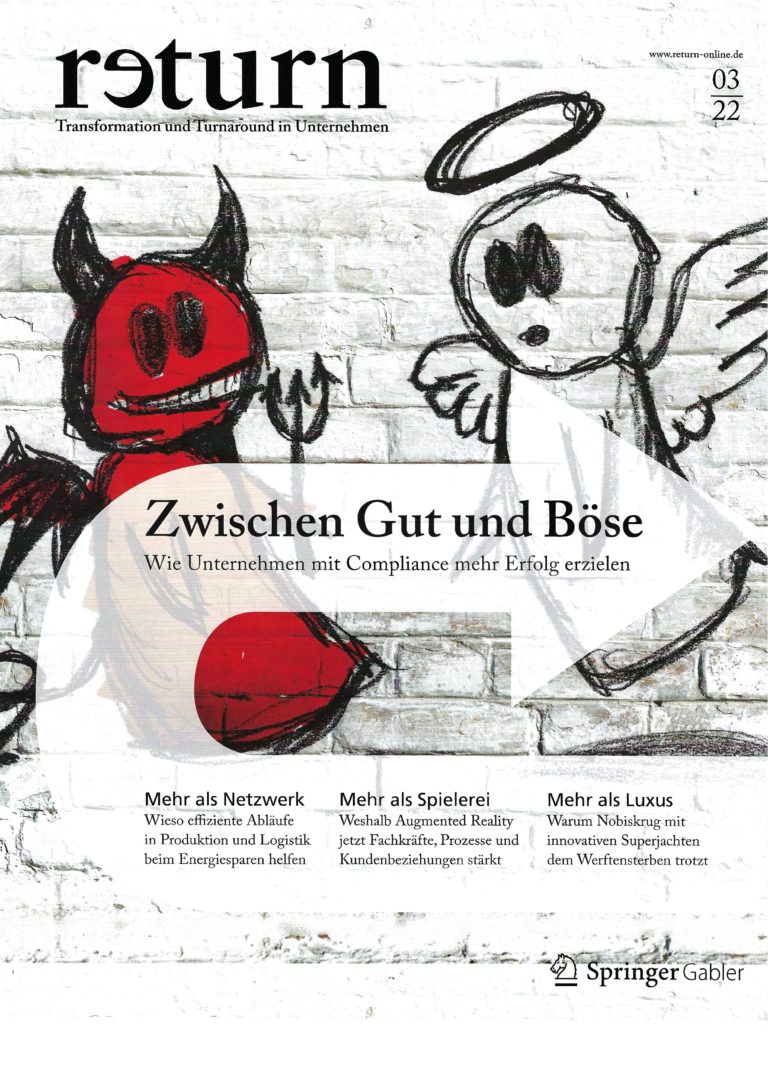
Human factor
Enlightenment instead of hopelessness: “return” reports in a practical way how to recognize crises at an early stage and how to avoid them in the best case.
An article by Sonja Stirnimann:
Risk Management – Forward-looking corporate management combats compliance violations, among other things, at an early stage.
Let’s talk about the human factor (2nd edition).
Social Engineering is not new nor is only conducted in business. Would you like to learn how to deal with social engineers? Being able to recognize the red flags and becoming a leader for the future? Join the journey of expanding the horizon, changing perspectives from manager to fraudster to leader to victim and responsible individual.
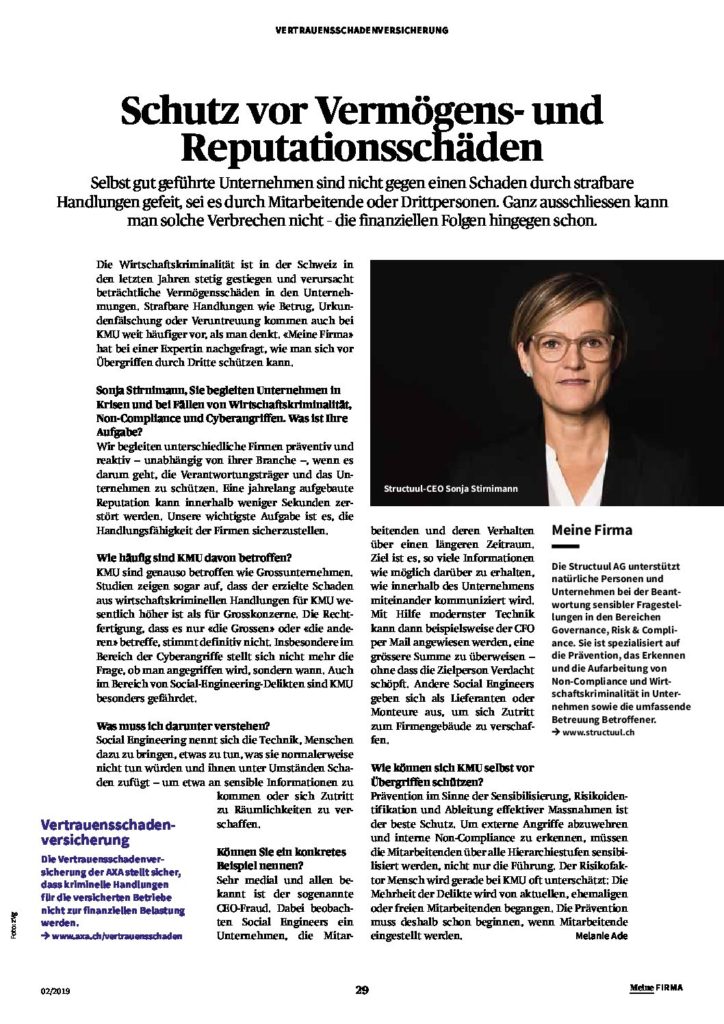
Protection against damage to assets and reputation (Meine Firma. Das KMU Magazin der Axa / 02.2019)
Even well-managed companies are not immune to damage from criminal acts, whether by employees or third parties. Such crimes cannot be completely ruled out – the financial consequences, on the other hand, can.

Ripped off! The investment fraudster Felix Vossen (ZDF info / 2019)
Felix Vossen – a radiant entrepreneur on the outside, a clever cheater in secret, wanted by FBI and Scotland Yard.

Spying employees - When the enemy sits in their own ranks (HANDELSBLATT / 2018)
What happens when employees steal data? The medium-sized company Compware Medical almost perished. A didactic play.

White-collar crime: the human factor (Compliance Praxis / 2018)
Interview with Sonja Stirnimann on the causes, motivations and life cycles of white-collar crime.

Tough, but hearty (HR Today / 2018)
When there is a fire, she blossoms into top form: Sonja Stirnimann accompanies companies in crises and in cases of white-collar crime, non-compliance and cyber attacks.
HR should think for itself (HR Today / 2018)
In the video portrait Sonja Stirnimann talks about what has shaped her and what she expects from human resources.

Ability to act in case of cybercrime emergency (ExpertSuisse / 2017)
Data loss and cyber attacks are business-critical operational risks in the digital world. A cyber attack can be life-threatening, especially for medium-sized companies, and jeopardize their continued existence. If non-compliance and white-collar crime (including cyber attacks) are suspected, correct action is indispensable.
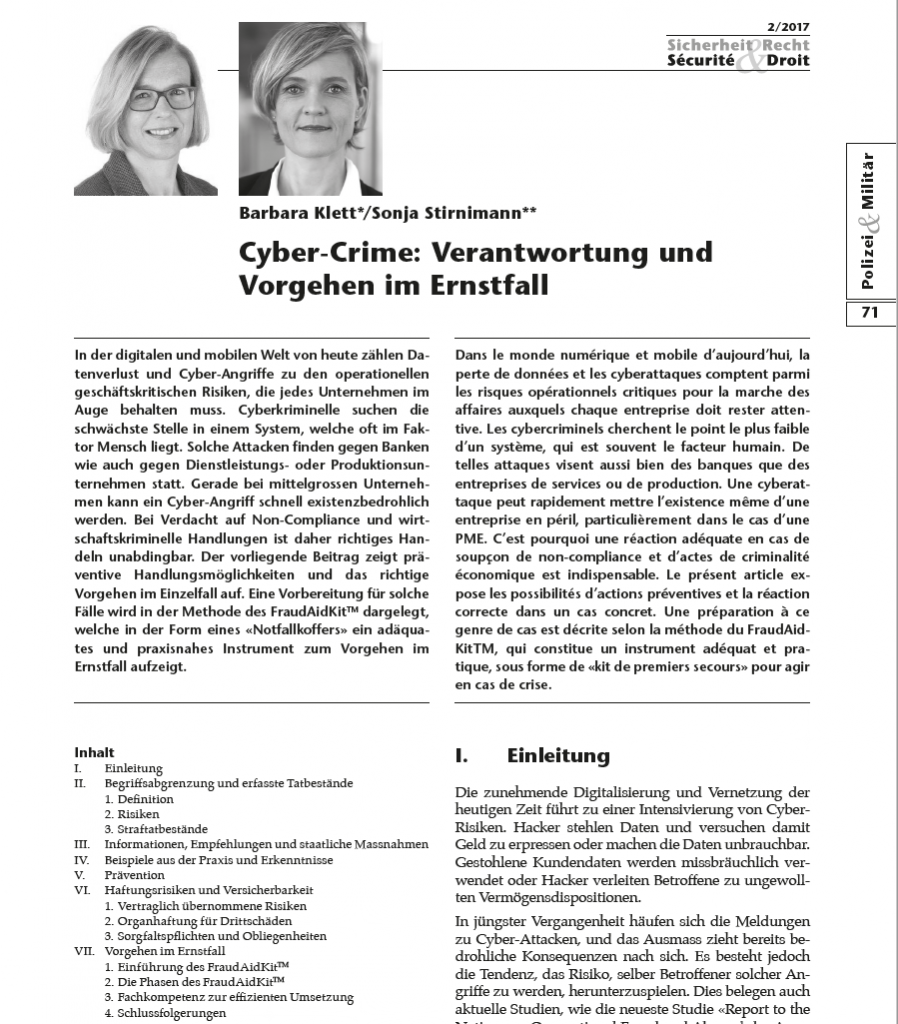
Responsibility and procedure in case of emergency (Sicherheit und Recht / 2017)
This article shows preventive options for action and the right approach in each individual case. A preparation for such cases is presented in the FraudAidKitTM method, which in the form of an “emergency kit” provides an adequate and practical instrument for dealing with emergencies.
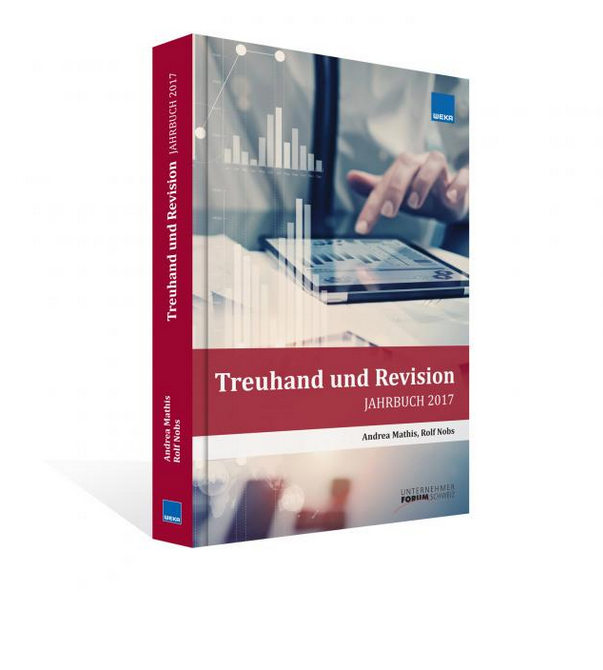
The auditor: Unbiased & responsible (Treuhand und Revision, Jahrbuch 2017)
Bias and its influence on the responsible role of financial statement makers, auditors and investigators are an omnipresent risk. Only if the experts are aware of this, know how to deal with it and know the measures to be taken is it possible to carry out an unimpeded audit or investigation.
excerpt of published information
Media.
The insights and perspectives gained from daily engagement with issues of governance, responsibility and the ability to act under pressure are incorporated into various public formats – including lectures, publications, discussions and other media formats.
Addressing these key issues is one of the preventive measures taken to protect our economy and society from (unintentional) misconduct that leads to compliance breaches, white-collar crime and cybercrime.
This raises awareness of business integrity, corporate governance and risk management. Understanding and preparing for these issues builds resilience.
Protecting assets is all about knowing "why".
Mastering challenges together.
The content of the following three publicly accessible formats, which can therefore be accessed at any time, is derived from specific situations and thus practical issues.
They are aimed at decision-makers who are concerned with the quality of decision-making, integrity and leadership in complex situations.
01.
Book.
The book is a condensed examination of a central aspect of my work: the human factor in governance, risk and integrity.
It focuses on the question of why organisations lose their bearings despite existing structures – and why incidents rarely fail because of rules, but rather because of decision-making and behavioural patterns.
02.
podcast.
In the podcast THE HUMAN FACTOR: Corporate Integrity Matters, I explore governance and integrity issues in conversation with decision-makers and experts from various industries.
This podcast is designed to be an engaging series. Its aim is to help listeners understand complex issues relating to corporate integrity, governance, human risk and leadership in both stable and exceptional circumstances.
03.
blog.
Based on over 30 years of professional experience in dealing with complex situations, I offer insights, reflections and practical ideas.
The blog serves as an archive of these reflections. It does not follow a publication schedule and does not claim to be up to date.
For leaders who prioritise integrity, clarity and transparency over vague intentions.
Knowledge creates transparency
Keynotes
To further raise awareness and strengthen corporate integrity and resilience, I discuss governance, accountability, and practical decision-making. I use anonymised real-life examples to illustrate how the ability to act can come under pressure despite the presence of formal structures.
My perspective is shaped by responsibility-sensitive decision-making situations at board and management level – in stable phases as well as in crises.
a.
Classification instead of recipes
In practice, governance rarely fails due to a lack of rules. More often, it fails due to human behaviour, delayed decisions or the desire for reassurance rather than clarity.
My lectures classify these dynamics. They do not explain how organisations should function, but rather reveal how responsibility is perceived in reality – and why integrity and consistency in action are crucial under pressure.
b.
Experience from challenging contexts
This perspective is complemented by experience from challenging contexts, including ocean sailing. Decisions under time pressure, with limited information and changing conditions are part of everyday life there.
These experiences serve as an analogy for leadership and governance in complex situations: preparation, clarification of roles and prudent action are more crucial than perfection.
c.
Formats and target groups
My keynotes and panel contributions are primarily aimed at:
- Board members,
- Audit Committees
- Executive boards
- those in positions of responsibility in complex environments.
They offer classification, orientation and reflection on responsibility and the ability to act under pressure.
These contributions appear in a variety of formats, including interviews, specialist articles and guest contributions. They offer a practical, objective assessment of complex issues.
Media classifications typically cover the following contexts:
- Governance and responsibility in the board of directors and management
- Ability to act under pressure and in crises
- Risk, non-compliance and human risk
- Integrity, trust and reputation
- Decision-making dynamics in uncertain situations
This page brings together publicly available formats. It has been carefully curated and does not claim to be exhaustive.

